Güçlü İndüksiyon, attaching a huge importance to R&D studies, has become able to project and produce almost all types of induction today. The company, which constantly improves its product and service quality and meets customer demands and expectations at the highest level, has produced almost 700 machines to date. We talked about the company and R&D studies with Yusuf Nisanci, the founder of Güçlü İndüksiyon.
Yusuf, can you please talk about yourself a bit?
I was born on April 2, 1952 in Amasya, Gumushacikoy, Maden Village. I am a graduate of electrical and electronics. I like my job, reading books, spending time in nature and driving a car.
Can you tell us about your company?
I founded my company Güçlü İndüksiyon on July 31, 1981. My purpose in establishing the company was to manufacture induction machinery, with all their parts, at our own facility. At the beginning, I started by setting up a workshop that performs maintenance and repair of winding elements, which have a great place in induction. We have become able to manufacture transformers and coils ourselves. In addition to repairing the magnetic materials and equipment consisting of winding elements, we were also able to design and manufacture new ones, and from 1984 onwards, I started to prepare the infrastructure of induction. This is how my company has come so far. We have manufactured around 700 machines. We have achieved a serious know-how. We have become able to project and manufacture almost all types of induction. I must say that I have received a huge academic support during this process. I am grateful to my friends for their trust and support. All my employees have served and worked selflessly, and they are still continuing to do so. This is such a work of the heart. I think we have implemented this in the best way. I believe that we will reach many more good days.
What would you like to say about your product range?
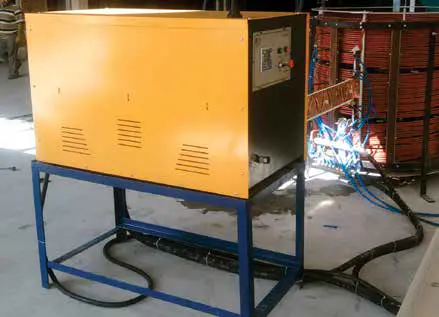
Our R&D work, started in 1984, yielded its first results on October 12, 2000, and we manufactured the first thyristor series resonance casting machine. Afterwards, we professionally manufactured parallel induction machines with thyristors of 400 to 600 kWh. We have put a lot of effort into this and have achieved success. Those machines are still working. Due to the fact that the costs of thyristor machines remain high compared to IGBT machines, we have switched to IGBT structures. In this case, we started to manufacture serial half bridge machinery first. Then we switched to IGBT-based full bridge machines and manufactured serial LCs, serial parallel structures, and then parallel structures. We can manufacture up to 40-50 kilohertz as a full bridge in our serial structure machines. Using silicon carbide construction, we have ensured our production up to 100 kHz. Technological developments are intensively transfered to us by our academic friends. I highly appreciate their efforts in this regard. I thank them so much. We have a lot of efforts and machinery related to defense industry and aerospace industry. We are currently aiming to manufacture a 400 kHz 100kva machine to be used in silicon carbide construction, with a project linked abroad. Manufacturing works are still ongoing. Unless otherwise develops, I believe the project will be completed by the end of May.
What exactly is induction? And what is the difference from other heating methods?
The induction effect is a discovery of Michael Faraday. When an energy that changes its direction is applied to a coil made of a good conductor such as copper, the direction of the magnetic field generated in the coil will change the direction as much as the frequency of the alternating current applied to the coil. If the frequency is 50 Hz, the direction of the magnetic field will change 50 thousand times per second, and if it is 10 kHz, 10 thousand times per second. It allows voltage to be induced by current flowing in the opposite direction of the current flowing through the coil to a conductive mass inserted into a magnetic field. If the resistance of the material in the coil is higher, it causes it to be converted into heat energy. The effect is directly proportional to the field current. A low-conductivity material inserted into a coil can be heated more easily. However, by changing the application methods, it has become possible to heat good conductors by induction. The frequency effect gives the temperature and depth change. We call it “penetration”. The “depth of immersion”, that is. When the frequency is reduced, the penetration (depth of immersion) increases, and when it is increased, the depth of immersion decreases. The electricity of the workpiece also depends on some of its magnetic properties. The heat generated outside the material by the penetration effect is transferred into the material by thermal conduction. The depth, to which the heat generated by the induced current will reach, is also directly related to the frequency at which the material is applied with the resistivity at the temperature it reaches, depending on the material property.
Heating by induction is a heating method that can be claimed to be the cleanest. Depending on the heat, the scale and material loss on the material are reduced to a much lesser extent compared to other heating methods. The heat in the heated material is homogeneous. Heat regulation is ensured much easier during production. In this way, the product standard is obtained. Heat regulation will become much easier when the current is controlled by the current flowing through the machine. This also increases the product standard. The investment cost is relatively low compared to others, and the area it would cover for application is less. In natural gas stoves, resistive and similar heating methods, heat transfer occurs through convection, i.e. radiation, from the outer wall of the material to the inside. In induction, on the other hand, the heat generated at the penetration depth determined by the frequency and the conductivity of the material at the current temperature is transferred directly into the material through thermal conduction. This is another expression of its efficiency. We can suggest that induction heating and melting is at the forefront of choices due to its advantages.
“We have achieved the R&D results of all the professional or scientific departments that constitute the induction, thanks to our own work, by paying the related fees.”
Do you export? Which markets do you export your products the most?
A small part of our products are export-oriented. Unfortunately, I cannot focus much on exporting, since I do not have a large manufacturing organization. I mainly export machines to the aviation and automotive industries.
What differentiates you from your competitors?
I see that we have quite a lot of differences from other competitors. First of all, we have achieved the R&D results of all the professional or scientific departments that constitute the induction, thanks to our own work, by paying the related fees. This prevented us from entering the manufacturing side so quickly in the beginning. But it also provided great advantages. Regardless of the sector or production method, we can design and produce the desired product in a short time. Currently, we have two unique products of our own. I would say that one of them has become completely commercial. I believe that we can commercialize the second one over time as well. If I remember correctly, we are the 6th country in the world in mobile-type induction manufacturing. I should say that this is an honor for us. When I founded my company, I targeted the best induction companies. Over the years, we have carried our know-how to peak by using common science intensively in our studies. We see and know that now. This is the main aspect that differentiates us from our competitors.
“All of our projects are unique to Güçlü İndüksiyon...”
Can you tell us about your R&D investments?
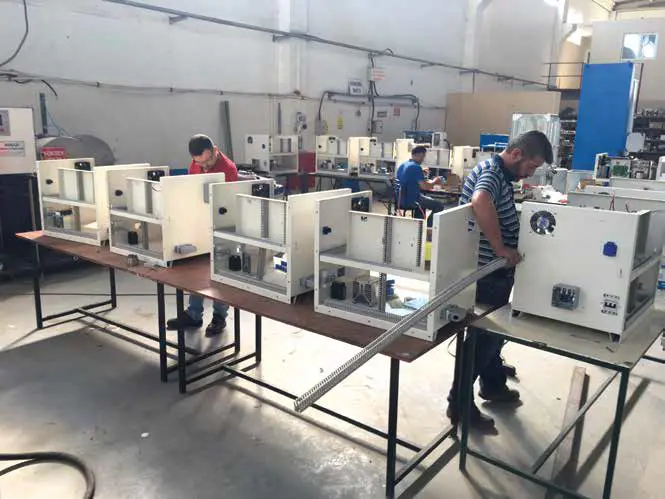
In none of our studies was any sampling taken from another study (another company, person, etc.). We have achieved this only by relying on the know-how that we have obtained with our own efforts. With this, we have showed our respect for the efforts put into other works. All of our projects are unique to Güçlü İndüksiyon. All the costs of our R&D studies, which continued from 1984 until the casting furnace was purchased in 2000, were borne by us. Also, the costs of the works we carried out to reach commercialization after the R&D studies yielded results in casting, were covered by us. Following the thyristor machinery we manufactured, many of the IGBT machines were also manufactured under our own responsibility and with our own capital, without selling the know-how to the customers. Very few of our first machines were manufactured with customer financing. As I mentioned above, starting manufacturing does not mean that our R&D studies are over. Our academic colleagues constantly offer support, and we are constantly researching how we can make things happen. We act with a belief that there will always be a “better” one. Our R&D investments are also still continuing. We are not slowing down our works to improve our products, and strive for making them even better. All types of induction machines, including control boards, transformers, feedback elements, high-frequency transformers and choke coils, as well as tunnel- and open-type heating coils, are manufactured at our plant. Software and design R&D are also being carried out entirely at our plant.
What can you say about your goals for 2022?
We have been able to manufacture more than 700 machinery so far, with the production activities we started in 2004 and 2005. We aim to increase this number to around 1000 in 2022. I hope we can achieve that.

Anything you want to add?
I should also state that we will continue our efforts to commercialize our 400 kHz high-frequency silicon carbide machine. We are still manufacturing the 10 and 20 kva power versions of our mobile induction as well. Also, the project works of those with 30 and 40 kva power is also continuing. We expect that the first manufacturing of 30-40 kva version will be completed in June. I would like to express that we will find a good market for these products. Our main goal is to find and take our place in the market with our own brand.