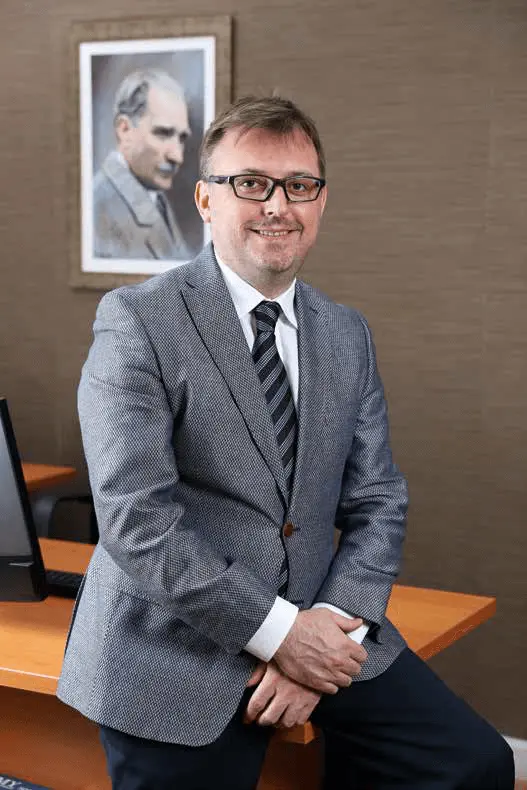
Today, communication has become an indispensable element that we rely on at every point of our lives. We desire to be accessible and able to connect to internet at any time, and have unlimited access to our remote data. In order for all these communication needs to be met, perfectly constructed infrastructures should be available. At this point, the companies such as SATELCOM come into play, creating sound communication infrastructures and providing easy access to data with satellite systems. We met with SATELCOM General Manager Murat Demirci and talked about their communication infrastructure, the systems they installed, and the overall functioning of the company.
First of all, can we get to know you a little?
I have been working as an electronic engineer for more than 20 years. I graduated Uludag University Electronic Engineering. Both during my university education and after my graduation, I worked part-time for almost five years on PCB design, micro-controller programming, and industrial automation, before completing my military obligation. I went to the US after my military service. I worked as a software and systems engineer in the field of industrial automation in the US for about four years. After I returned to Türkiye, I started working in the GSM sector and after three years I started working as a manager at another company.
Can we learn the foundation story of Satelcom?
After I returned to Türkiye, I worked in several companies in the field of GSM. In 2014, I met with Davut Yurttas and Mustafa Yurttas and together we founded Satelcom. We are working on cable and wireless communication technologies at Satelcom.
Can you tell us about the areas of operation of Satelcom in general?
Technology is in a crazy transformation process, creating all kinds of environments that will make people’s lives easier. People are discarding a hardware just six months after they bought, claiming that it is “outdated”. Keeping up with this speed is not easy not only for the manufacturers, but also for the companies in fierce competition. Satelcom has two main fields of operation: Engineering and integration in the field of communication. In other words, we deliver turnkey projects using the products of the companies, which we are a distributor of. We also carry out R&D and manufacturing activities on communication technologies. We manage the distributorship of the products ourselves. At the next stage after the research and development stages, we also receive services from our group companies in our manufacturing processes. For example, we are buying components from Ozdisan Elektronik. In turn, we are developing projects that will meet the wireless communication requirements of their own customers.
”We allow the companies to access data via satellites in the locations where there is no internet.”
What are the main business lines at Satelcom?

We have three main business lines. The first is cellular technologies. Cellular technologies are the technologies used in the infrastructures of mobile phone operators. (2G, 3G, 4.5G) We supply products to operators in these fields. They can supply the radio frequency related products that they use on their networks from us. We are able to install the entire base station infrastructure. At Satelcom, we do turnkey business. In other words, we undertake all the business processes internally, from the project design to the supply, import, on-site installation, commissioning and testing of the products to the delivery of them to the operators. For example, let me give you an example from the job we completed at Atasehir Watercarden shopping mall, to explain in detail what we are doing. In order to provide mobile phone services at this shopping mall, a system needed to be established for each operator concurrently, and we put this system into operation. Usually problems occur when reaching the base stations on the towers outside the building due to reasons such as the permeability of the buildings or its distance to such towers. Also, due to the large number of users, it is necessary to create a new coverage area by setting up a separate base station in buildings such as airports, tunnels, hospitals, shopping malls. All the processes, including the installation and testing of the system, as well as submitting the results of these tests to the operators, are managed by us. At this point, I have to underline that the demand comes from GSM operators, not from shopping malls. In other words, our customers are GSM operators, not the shopping malls themselves. In order to meet the demands of both the operator and the building owners, we need to arrange our working hours in a way that does not affect the customers’ businesses. We install an entire infrastructure and deliver it to our customer in a running state. There are also antennas, components, connectors, aref cables, power systems, batteries, and test-related software used at base stations, that we sell directly to the operators. We are able to sell them directly, without any intermediate parties. All of these are our GSM-related operations.

Our second line of business, on the other hand, is satellite-related infrastructure services and integration engineering works. With satellite, I don’t refer to those that work one-way at our houses, but to the satellites that are used for two-way data exchange. In other words, the satellite terminals where we can both send and receive signals. We are able to supply products from the companies that we are a distribute of in this field, and meet the needs of our customers from a single point. Our customers in this field are usually the companies that operate in media sector. In other words, television channels, radio stations and news agencies receive services from us.
We are also able to provide satellite services to our customers. For example, Gentek is a company specializing in sensor technologies and the sensors they produce need to be gathered in cloud. The data should be written and accessible in order that the company can control them. They also need a data infrastructure to collect these data. We allow such companies to access data via satellites in locations where there is no internet. Another example would be, DMY Electronic Investments has established a solar power plant in Kas. This power plant is located atop of a mountain, far from the settlement areas, in a place where there is no GSM coverage. The company needs to be able to remotely monitor the inverters that produce energy there. Also, the data generated at the plant must be written to a cloud environment and remotely observable. In order to respond to the needs there, we have placed a satellite in the area where the power plant is located. With this, the company has gained the opportunity to access all kinds of data via satellite. Our third line of business is actually a business line similar to the examples I have just given. This line, called telemetry or M2M, can either be assessed alone or together with the others. In this field, we offer infrastructure services to migrate the data created by the equipment to a specific location. For instance, you have sensors and also equipment that will be remotely controlled. We are building infrastructures that will enable them to communicate in two directions. If we are also asked to provide sensors, we can do that as well. If we are asked to install a control system, we can get support from Savior, which is our group company.

“We already used to be able to connect objects to a central point, but now the number of things we can do in this regard has expanded.”
What would you like to say about the Internet of Things?
The communication networks, so-called Internet of Things, in which physical objects are connected to each other or larger systems, have actually been around for years. Various protocols have been created over the years to allow a number of equipment, especially those used in the field of industrial automation, to communicate with central management systems. Although the communication between different equipment is thought to be only via smartphones and internet, many equipment have already been able to communicate with each other for many years. With the pioneering of GSM infrastructures, the quantities and speeds of the data transported began to increase. With the increase in speed, it has become easier to transmit a huge number of external data such as images and audio, as well as other small data. Thus, its popularity has increased. As the technology has advanced, the software and connectivity capabilities of the devices have also increased. Today, every object can be connected to internet. This has now started to be called the Internet of Things. We already used to be able to connect objects to a central point, but now the number of things we can do in this regard has expanded. For example, if your child is going to come home before you do, you can turn on your boiler an hour before with remote management and watch your house over the camera remotely. All these devices should have an internet connection so that you can manage them remotely. As the variety of these devices increases, they have become more involved in our lives.
“At Satelcom, we undertake all the business processes internally, from the project design to the supply, import, on-site installation, commissioning and testing of the products to the delivery of them to the operators.”
What do you think is the reason behind the popularity of cloud technologies?

Cloud technologies have become very popular since they make life easier. In the past, you had to create the system that you could access, setting up your own cloud by yourself. You had to allocate a certain budget to keep this system running. Although the amount of data you would manage was not so large, you had to allocate a significant amount of money. In other words, the capacity and infrastructure you created could pretty exceed your actual use. In cloud technology, you don't know where your information is stored. If you have rented a space from Amazon to store the data you have created, your data may be stored in Silicon Valley. When a maintenance is performed at the current location where your data is stored, it can be redirected to another center. In this way, you can get uninterrupted service without being affected by the maintenance. When investing for a data center, they usually try to choose places where the temperature profile is stable throughout the year. In this way, they are able to invest without extra costs for heating and cooling.