
LED TECHNOLOGIES SALES MANAGER
Connectivity is perhaps the most popular subject in the lighting world nowadays. Still, the overall progress is not as fast as expected. Although it remains as an area that we all kept a distance from due to the complexity of the system and standardization, the situation is changing now. The MasterConnect system developed by Philips claims to be a solution to all the problems of connected lighting. Therefore, in this issue we will introduce Signify’s perspective on this issue and the MasterConnect system, whose motto is “simple, scalable and standardized”.
The Challenge of Connectivity
The benefits of lighting automation are incredible. From schools, offices and hospitals, to retail, warehousing and industry, it offers many advantages together, such as cost savings, greater comfort and significant productivity gains. However, without a wireless communication standard that guarantees interoperability between lighting fixtures, and without a professional support, it will never achieve the mass adoption it deserves. Interoperability requires local control at the level of a fixture, then a room or a building. The first can be achieved using control nodes such as sensors connected to lighting fixtures supported by SR or D4i drives, while the second and third require a BLE (Low-Power Bluetooth) local connection and a Mesh network. Therefore, the current race is to find an industry standard that will not take the risk of sticking with a single provider and will make connected lighting more attractive to customers.
Simple Operation
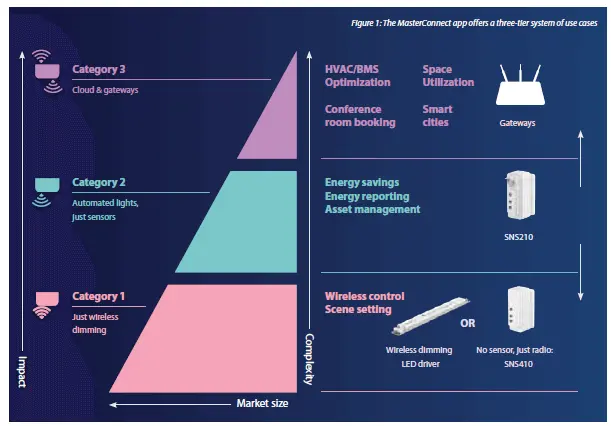
Approaching this from different perspectives depending on the use case in hand, Signify seems to have found the perfect solution that is simple, scalable and standardized. In the system, products from different lighting manufacturers can communicate equally within a connected lighting system using the same standard wireless protocol. Since the system is not dependent to a particular supplier, the customers can switch between different manufacturers, making sure that their lighting systems will continue to work. Also, installation companies can create highly customized solutions using different products and the ones that best suit customer needs. Now, let's see how this works. Signify’s new system guarantees the interoperability of components by using the Philips MasterConnect application to control drives, sensors, switches and potential gateways in a connected lighting network. The MasterConnect application offers the customers a simple and ready-made lighting system with features that add value beyond lighting. The system is installed and configured via BLE technology with an innovative point and trigger approach that uses a flashlight to activate the lighting within the network. Thus, both time and financial resources are used efficiently. Moreover, the concept is highly scalable, as most of the components from Philips or third-party manufacturers can be added to the created lighting network or upgraded within the lighting ecosystem. With this flexibility, it is possible to create a simple independent system, an advanced gateway solution, or anything in between. (see Figure 1). Since standardization is a necessity, the entire system is built around Bluetooth Low Energy (BLE) and Zigbee for maximum ease of deployment and reliability. For the installation of a wireless connected system, it only requires a Bluetooth connection via the application,which means that the configuration can be done in the field even if there is no internet connection. Now, let's examine the MasterConnect System in different usage scenarios.
Category 1: Getting Started
A simple standalone system
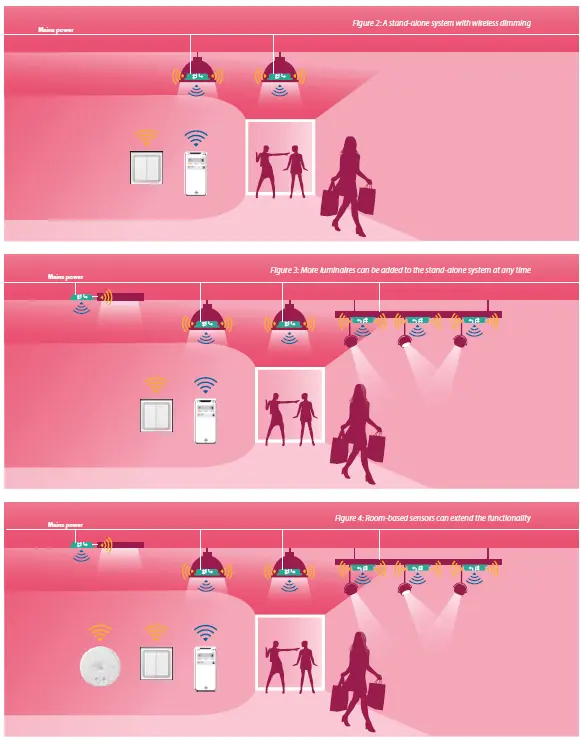
This indoor lighting architecture is an independent system that allows wireless dimming at a basic level by using wireless lighting components. A simple network or group of wireless drives together with a switch can be easily installed via the Philips MasterConnect application. In this way, dimming and scene adjustment are ensured by using the Zigbee Green Power (ZGP) energy collection switch. (see Figure 2) At any time, this wireless network or group can be adapted according to the requirements or building layout changes, or expanded by adding more fixtures, all of which can be done via the MasterConnect application. (see Figure 3) By adding external room-based sensors, such as the Philips EasyAIR Occupation Daylight ZGP sensors, it is also possible to enjoy scene control and, on top of that, functionality. (see Figure 4) For instance, the presence and daylight detection can save energy by turning lights on and off or reducing lighting levels when there is sufficient natural light. Task-tuning can also be used to personalize light levels according to individual needs, which improves both concentration and productivity. Category 1 solutions aim to realize a project in a cost-effective way and are ideal for room-based applications. Whether in retail and accommodation, or office or industrial areas, you can easily build your system using the MasterConnect application in combination with wireless components. But, what if we want to take things to a next level?
Category 2: Get more control
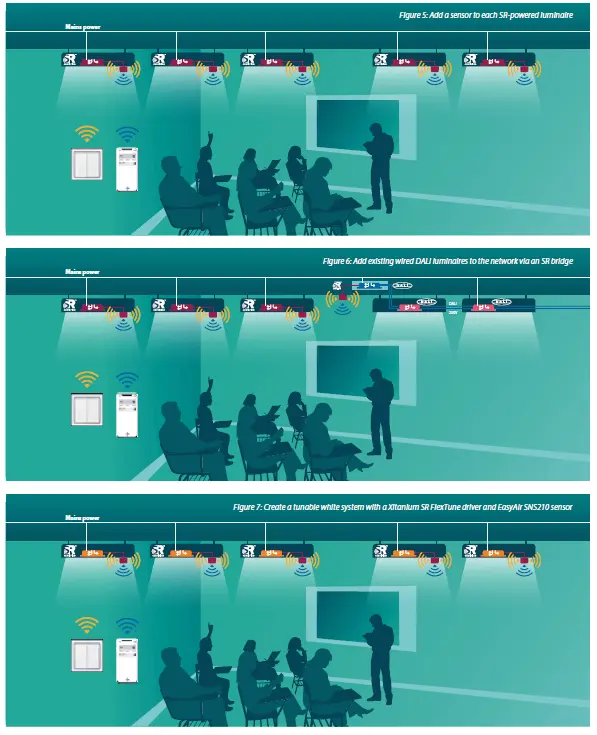
In a Category 2 use case of an independent system with Granular Dimming, an extra degree of control has been added to the existing lighting installation. The obvious benefits are more energy savings, scene creation opportunities and human-oriented features for a facility manager, and a more comfortable lighting experience for users of lighting. In this installation, the Philips EasyAIR SNS210 sensors in each fixture (see Fig. 5) reacts to the occupancy situation in certain areas. When motion is detected, Zigbee Mesh informs all other fixtures in the network. In response to this warning, the entire network reacts in the same way by turning the lights to a certain level of dimness, or dimming them if there is no one out there. In this way, each light can be adjusted to its own dimness level and thus granular control is achieved. Also, if switches are added, they can control the lighting not only for the entire group but also for subgroups or regions as well. The lights gradually turn on to full brightness when people arrive at their workplace, or turn down to background levels when they leave. This maximizes energy savings when people take a lunch break, attend a meeting or leave the workplace in the evening. In this scenario, it is also possible to integrate existing DALI fixtures into the system by integrating a Philips Xitanium SR bridge with the fixture-mounted sensors. (see Figure 6) This gives the customers the flexibility to control occupancy detection, energy saving and scene setting for downlight applications or a group of fixtures using multiple DALI drives. For instance, this installation will be suitable for renovation projects where the existing DALI installation is requested to be reused. It is also possible to create a simple adjustable white system using a Philips Xitanium SR FlexTune drive and a Philips EasyAIR SNS210 MC on each fixture. (see Figure 7) With the unique FlexTune dimming feature, these drives can be dimmed up to 1% using a manual ZGP switch and maintain color accuracy and consistency throughout the entire adjustment range. This type of application is widely recommended for classroom environments, as it can positively contribute to the concentration level of students. One of the main advantages of our connected system, which works with the Philips MasterConnect application, is the easy and fast commissioning. In projects involving hundreds of fixtures, commissioning in the field is extremely time-consuming, which leads to increased installation costs. Therefore, Signify has developed torch-based commissioning as part of its connected system, which has proven to be very effective: When you point the torch at the built-in sensor on the fixture, the MasterConnect application instantly responds, recognizes the luminaire and adds it to the mesh network. This process is so simple that it does not require training and offer lower installation costs compared to conventional wired or wireless systems on the market.
Category 2 solutions are ideal for fixture-based control applications. Although it requires a higher initial investment cost compared to Category 1 solutions, it offers much more energy savings. For maximum benefit, you can apply this solution to offices (corridors, conference rooms, hallways), schools (classrooms, canteens, toilets), hospitals (patient wards, reception areas) or other similar areas. But this may still not be enough. What if customers have more ambitious ideas to build a larger infrastructure that can offer significant commercial, operational and financial advantages?
Category 3: An IoT Solution integrated with the gateway
Achieve full integration. As we mentioned earlier, the Philips MasterConnect application is a solution that combines all components in a fully integrated and connected network to add even more value to lighting. (see Figure 8) As can be seen, this third usage scenario builds on the previous two scenarios by connecting the MasterConnect application to armatures, drivers, sensors, nodes. But this time, it is also connected to a gateway that controls all lighting in smaller networks. Thus, the doors of the whole world of advanced usage scenarios, from time planning to the use of free space, are opened. For instance, the gateway can be used to define complex scenarios such as the control of groups or their subgroups that require different fixture or switch behaviors at different times of the day. Energy measurement and automatic energy reporting can offer valuable information about how and where customers can save on electricity. As part of a smarter building management system, it is also possible to process occupancy information to determine vacancies in flexible workspaces or meeting room reservations. Moreover, and behind the scenes, the gateway provides the customers with access to diagnostic and predictive maintenance data, which can reduce operating costs and eliminate expensive downtime.
Open standards for maximized end-user preferences
The essence of the lighting systems that work with the Philips MasterConnect application is that they are based on open standards. This means that a customer can start with a simple standalone lighting system and then add a suitable gateway when the building requires further development. With MasterConenct, it is possible to achieve all this without becoming dependent on any vendor or experiencing compatibility problems with new products or component versions. It is not difficult to foresee that connected lighting will become mainstream in the future when the industry has accepted, inter-operable and open standards. Having pioneered the D4i in-fixture standard, Signify's current goal is to standardize the wireless protocol to ensure industry-wide interoperability. The Philips MasterConnect application claims to be the first solution to eliminate obstacles to mainstream connected lighting systems and pave the way for a smarter connected future by making this system possible for the first time.