
LED TECHNOLOGIES SALES OFFICER
LED (light emitting diode), which continues its development as the future of the lighting world, is an electronic circuit element that converts electrical energy into light. In addition to various areas of use, one of the most common areas of use is the lighting sector. LEDs, which are also used as light sources for lighting fixtures, achieve successful results in several terms such as low energy consumption, service life, low ultraviolet and infrared radiation, higher color rendering and flexibility of use. LED lighting systems, which are starting to take a greater place in our lives every day with the advantages they offer against conventional light sources, offer innovative and timeless solutions. With the improvement in light efficiency, it seems possible that they will completely replace other light sources used in conventional lighting in a near future. As a result of the widespread adoption of LED technology, prices in the LED lighting market are also falling significantly over time. LED manufacturers are also constantly improving their technologies, and entering price competition to get a better share of the market. In order to survive in this fierce competition, manufacturers may release products in different structures to the market from time to time, or manufacture products in the same class with different materials. These different materials determine the quality class of the LED, affecting several factors such as performance, efficiency, lifetime, light intensity, etc. In this article, we will examine the characteristics of several different materials used in LED cases and connection wires, as well as the factors affecting the quality of the LED.
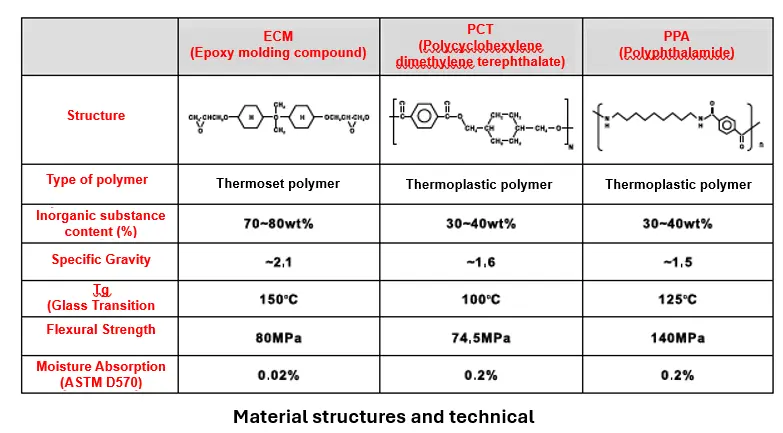
LED Case Materials and Specifications:

The LED case is the material that protects the chip inside, provides ease of installation, increases product durability and wraps the phosphor. Different materials are used in the manufacture of this material. However, ceramic, which is a material with strong heat resistance that provides the highest performance in high-power LEDs, is usually preferred. In the medium/low-power LEDs that we will examine in our article, on the other hand, PPA (polyphthalamide), PCT (Polycyclohexylenedimethylene terephthalate) and EMC (Epoxy Molding Compound) are commonly used. PPA injection molding method is ensured by stamping method with low PCT fluidity, and EMC is manufactured by closed-cycle die casting method. PPA and PCT are thermoplastic materials, while EMC is a thermoset material that contains epoxy resin. Due to their material structures, all these 3 materials have different heat dissipation and temperature resistance properties. The temperature resistance of EMC is higher than PCT, and the resistance of PCT is higher than PPA. The cost of a material with high strength is higher due to both the production technique and the material content. Although the reflectivity rate of PPA material is the highest (>95%), its yellowing, thermal resistance and weather sealing values are lower than those of others. Although the reflectivity rate of PCT material is lower, its temperature and strength resistance rate is higher than PPA. EMC, on the other hand, has the advantage of high thermal and high yellowing resistance, high current carrying value, high power and UV resistance, as well as small size. Based on their temperature resistance, PPA is resistant to a maximum power of 0.2W, PCT is resistant to a power of 0.8W, and EMC is resistant to a power of 3W.
“One of the most important factors affecting LED quality is the properties of the materials it is made of.”
Connection Wire Materials and Characteristics;
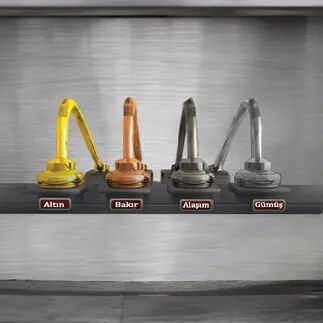
Connection wires are conductive wires that provide the electrical connection between the chip and the mounting pads. Damage to these wires causes the electrical transmission to be interrupted, the LED to malfunction, or its life to shorten. 4 different kinds of materials are used in connection wires, namely gold, copper, silver and alloy. We can summarize the properties of these wires as follows.

Golden Wires;
● It is the highest quality wire used in high quality LEDs.
● Since the gold is a soft material, the connection between the chip and the mounting pads can easily be made by heat, pressure and ultrasonic energy (Thermosonic connection), providing ease of manufacture. Manufacturing errors due to field use are minimized.
● It has the most suitable electrical and thermal conductivity for LED.
● The most stable performance is achieved.
● It provides a high bond strength.
● The oxidation resistance is high.
● It is the most expensive option due to the constant increase in gold prices.

Copper Wires;
● Bond strength is 25-30% higher than gold wires. However, it can be easily oxidized at a relatively low temperature, and the bond strength decreases.
● The storage life is low. Requires coating.
● It is a hard material. The connection between the chip and the mounting pads requires more heat, pressure and ultrasonic energy. The formation of micro-cracks is higher, and the manufacturing error rate due to field-use is higher.
Silver Wires;
● The storage life is higher than copper wires. There is no need for an external coating.
● It is cheaper than gold wire, more expensive than copper wire.
● There is no need for gas protection.
● Wire durability is not as strong as that of gold.
Alloy Wires;
● The metal ratios used in the alloy are not stable as they vary according to manufacturers.
● It is cheaper than gold, more expensive than copper.
● It provides a high bond strength.
● The oxidation resistance is lower than that of gold.

In conclusion, there are certain technical characteristics that each material used in the LED case can reach due to its structure. When the product is designed within these limits, a quality product can be obtained. However, the factor that determines the quality of the product at this point is the “sales price policy” of the LED manufacturer rather than the “structure of the material”. Usually, when determining the technical characteristics of the product, manufacturers can apply different strategies according to the market conditions. One manufacturer can manufacture a 0.5W LED as a PPA, another as a PCT case, or a 1.2W LED as a PCT, while another manufacturer can manufacture the same as EMC. If PPA is used above 0.2W and PCT above 0.8W, it will create much more heat than other options. Accordingly, either more refrigerant should be used in this product, which will increase the cost, or the resulting heat will seriously reduce the service life and efficiency of the LED. Due to the price advantage offered by the regular connection wires, copper and silver wire are primarily preferred in low quality LEDs, while gold wire is widely preferred as it provides the most favorable conditions for high quality LEDs. However, due to the increasing gold prices, the use of alloy wire is also increasing daily. When alloy wire is used, the factor affecting the LED quality and service life will be the metal content ratios.