
FIELD APPLICATION ENGINEER
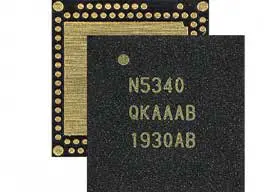
Nordic Semiconductor, which Ozdisan Elektronik is a distributor of, closely follows not only the current Bluetooth technologies but also the innovations put forward by the ARM architecture it uses. In this article, we will talk about the dual processor feature of nRF5340chip the Nordic Semiconductor company has just released, as well as the features of ARM TrustZone and CryptoCell integrated into it. While all of Nordic’s existing products had an ARM processor architecture and an RF layer (Bluetooth, Thread, Mesh, 2.4Ghz, etc.) built on this architecture, its new product nRF5340 processor is equipped with dual cores separated from each other. This allows the operations performed on the RF side to be executed on a processor dedicated solely to this feature, while user code and algorithms can be executed on another different processor. In addition, the company did not neglect to use the ARM Cortex M23/33 core, which offers TrustZone support by ARM and targets security in the IoT (Internet of Things). TrustZone functions by creating a secure mode of operation that allows security functions and encryption credentials to be hidden from the processor environment. Its most important benefit is that it prevents software vulnerabilities that are used to gain access from one execution environment to another. However, a truly secure IoT (Internet of Things) device requires more than just this isolated “Trusted Platform Module”, such as additional trust roots (ROTS) and security mechanisms. To meet this requirement, ARM complements TrustZone with CryptoCell. CryptoCell is a built-in security platform for devices that already use TrustZone and provides more security, while also improving processor performance. The technology consists of a multi-layered architecture that combines a hardware bus, RoT management and a process control integrated with security software. In addition to improving security, it reduces the transition between “Trusted Execution Environments” (TEEs) and normal mode, where power consumption is low and processing speed is high.
TrustZone functions by creating a secure mode of operation that allows security functions and encryption credentials to be hidden from the processor environment.
How does CryptoCell work?
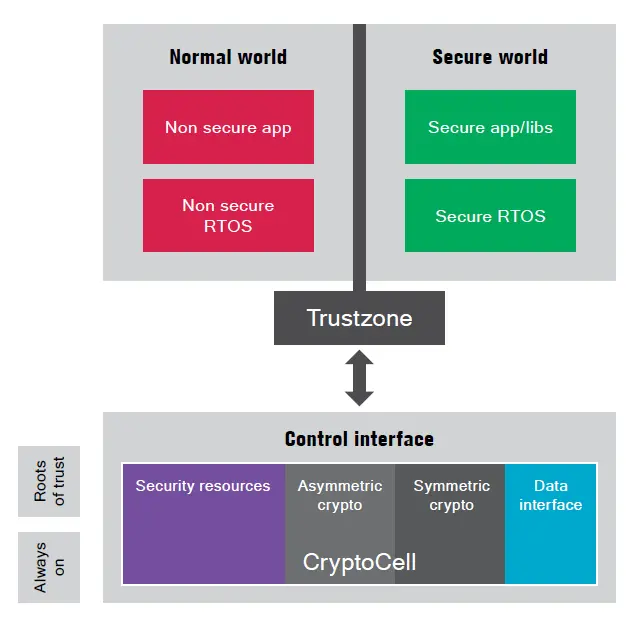
During the life cycle of an IoT (Internet of Things) device, the device is subject to multiple processes such as manufacturing, transportation, distribution and disposal. CryptoCell’s main objective is to offer security services that protect the integrity, authenticity and confidentiality of several assets (such as code and data) belonging to different stakeholders (e.g. semiconductor vendors, OEMs, and consumers), by building sound trust between these parties. The technology links different security policies with each device. ARM’s latest product CryptoCell-312 is divided into five sections: Control, data interface, symmetric cryptology, asymmetric cryptology and security resources. As can be seen in the figure, CryptoCell's control interface communicates directly with TrustZone. Security resources are the section where the security elements of CryptoCell are activated, usually using cryptography and non-device tools. These security elements include: Route management; IP protection (code confidentiality); persistent and volatile data protection; secure debugging and feature activation. The key elements serve the RoT; these elements use non-volatile on-chip storage that is only accessible by CryptoCell and cannot be modified or accessed by unauthorized parties. The RoT can be in the form of keys used for various purposes and belonging to different organizations, or other information about the status of the device. CryptoCell also supports a RoT competency model that allows for multiple authorizations and multiple RoT clusters, allowing different parties (e.g. semiconductor vendors, OEMs, and service providers) to own the processes and make money without having to depend on each other. Together with the nRF5340, we will be able to not only find solutions to the security-related issues but also to handle the Bluetooth communication easily.
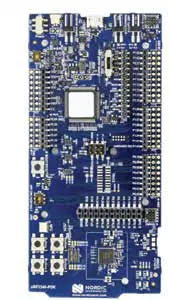
Particularly in the sectors where data processing is important, such as the medical sector, high processing speed and well-equipped solutions are always in demand. The nRF5340 Bluetooth chip is also preferred for such data-intensive applications. While general tasks are done quickly with one core inside, the wireless communication side reaches a solution quickly with the other core. Ozdisan Elektronik, as the authorized distributor of Nordic Semiconductor, offers both the nRF5340 chip and development kits from its inventory to its customers who want to develop with this chip. This allows our customers to make the required tests with the development kit, without making any specific design. There are four user-controlled LEDs and Buttons on it. Also, an Arduino pin array is available to make it possible to use several sensor kits developed for the widely used Arduino platform. In addition, it creates an environment for conducting distance tests with PCB-type antennas and the antennas with Ipex connector. The development kit also includes a Segger programming unit. Thus, it offers the possibility of programming the chip on the development kit and programming your own product that you will design.